Chapter 2 - Epithelium
Epithelial tissue is one of the four fundamental tissue types in the body. It consists of closely packed cells arranged in continuous sheets that cover all external body surfaces and line internal cavities and organs. Beyond acting as a protective layer, an epithelium also functions as a selective barrier, regulating the passage of ions, molecules, and cells between compartments.
The basement membrane is a thin, specialized layer of the extracellular matrix that anchors the epithelium to the underlying connective tissue. It serves as an interface through which nutrients and waste products are exchanged by diffusion.
Epithelia Classification
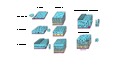
Epithelial tissues are classified using three morphological criteria:
- Number of Cell Layers:
- Simple Epithelium: Single layer of cells optimized for rapid exchange between compartments but offers minimal mechanical protection
- Stratified Epithelium: Two or more layers that prioritize protection against abrasion and physical stress
- Pseudostratified Epithelium: Type of simple epithelium that appears layered because the nuclei of its cells are at different heights, but every cell maintains direct contact with the basement membrane
- Cell Shape: Assessed at the free (apical) surface and describes the outermost layer in stratified tissues.
- Squamous Cells: Flattened cells typically with a thin nucleus
- Cuboidal Cells: Roughly as tall as they are wide, with a central, spherical nucleus
- Columnar Cells: Taller than wide, with the nucleus usually located near the base
- Surface Specializations: Modifications to meet specific functional demands.
- Cilia: Hair-like, motile projections that move substances (like mucus) across the surface
- Keratin: Protective, water-insoluble protein layer found in the surface cells of skin
- Goblet Cells: Specialized columnar cells that secrete lubricating mucus
The number of layers is combined with the cell shape to give the full classification (e.g., simple squamous, stratified squamous, simple columnar). The presence of keratin and goblet cells is usually included when present (e.g., keratinized stratified squamous).
Transitional epithelium (urothelium) is another type of epithelium that lines the urinary bladder and ureters. Unlike other epithelial types, it has the unique ability to stretch and relax as these organs fill and empty.
Cellular Polarization
A defining characteristic of epithelial cells is their structural and functional polarity, meaning the cell is organized into distinct domains with specialized functions:
- Apical Domain: Free surface that faces the lumen or exterior environment often with surface specializations
- Lateral Domain: Surfaces facing adjacent cells with intercellular junctions that hold the epithelial sheet together and regulate what can pass between cells
- Basal Domain: "Bottom" surface attached to the underlying basement membrane
Simple Squamous Epithelium
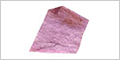
Simple squamous epithelium is composed of a single layer of flattened cells. Because of its extreme thinness, it is specialized for efficient diffusion, filtration, and absorption across the epithelium, but provides minimal mechanical protection.




Simple Cuboidal Epithelium
Simple cuboidal epithelium consists of a single layer of cube-shaped cells with large, round, centrally located nuclei. More metabolically active than squamous cells, it is specialized for secretion and absorption.

Simple Columnar Epithelium
Simple columnar epithelium is made of a single layer of tall, narrow cells packed closely together, with nuclei located near the base. It is specialized for absorption (often with microvilli) or secretion (secretion granules).


Pseudostratified Columnar Epithelium
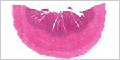
Pseudostratified epithelium is a specialized simple epithelium that appears to be layered because the nuclei are positioned at different heights. Every cell is in contact with the basement membrane, but not all cells reach the apical surface.


Stratified Squamous Epithelium
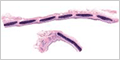
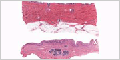
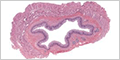
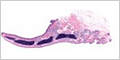
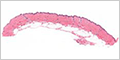
Stratified squamous epithelium is the most widespread stratified tissue, consisting of multiple layers of cells that transition from cuboidal at the basal layer to flat at the surface. Its primary role is protection against mechanical abrasion, chemical exposure, and pathogens.
It exists in two forms: keratinized, in which surface cells are filled with a tough protein keratin to form a dry outer layer of the skin; and non-keratinized, which remains moist and lines high-friction passageways such as the mouth, esophagus, and vagina.
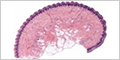

Stratified Cuboidal Epithelium
Stratified cuboidal epithelium is relatively rare and typically consists of only two or three layers of cells. It provides additional protection and structural integrity in larger ducts of sweat, mammary, and salivary glands.
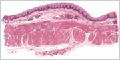
Stratified Columnar Epithelium
Stratified columnar epithelium is even rarer and consists of multiple layers of cells in which only the outer layer is columnar in shape. The deeper layers are cuboidal to polyhedral. It is restricted to small transition zones, such as the conjunctiva of the eye, parts of the pharynx, and the male urethra, where it serves a protective and secretory role.

Transitional Epithelium
Transitional epithelium (urothelium) is a highly specialized stratified epithelium found exclusively in the urinary system, lining the bladder, ureters, and proximal urethra. It has the unique ability to stretch as these organs fill. When relaxed, the large dome-shaped “umbrella cells” cover the surface; as the organ distends, the epithelium thins and the cells flatten to accommodate the increased volume.