Chapter 17 - Respiratory System
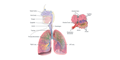
The respiratory system is responsible for taking in oxygen and expelling carbon dioxide. It can be divided functionally into two regions:
- Conducting portion - conveys air to the lungs while removing debris, warming, and humidifying the air (nasal cavity, pharynx, larynx, trachea, bronchi, and bronchioles)
- Respiratory portion - where the exchange of gases between air and blood occurs (respiratory bronchioles, alveolar ducts, alveolar sacs, and alveoli)
Respiratory Epithelium
Respiratory epithelium is a pseudostratified ciliated columnar epithelium with goblet cells that covers most regions of the conducting portion of the airways.


LUNG
The adult lungs are sponge-like organs whose main function is to provide oxygen and remove carbon dioxide from blood.


Respiratory Bronchiole
Respiratory bronchioles are the beginning of the airways involved in the exchange of gases.


Alveoli
Alveoli are sac-like evaginations from respiratory bronchioles alveolar ducts, and alveolar sacs. Between neighboring alveoli lie thin interalveolar septa containing capillaries.


The alveolar epithelium comprises two main cell types:
- Type I Alveolar Cell - very attenuated cytoplasm and site of gas exchange
- Type II Alveolar Cell - produce pulmonary surfactant
Type I cells are large flat cells that comprise 95% of the alveolar surface. Type II cells are small cuboidal cells that cover the rest of the alveolar surface.


